
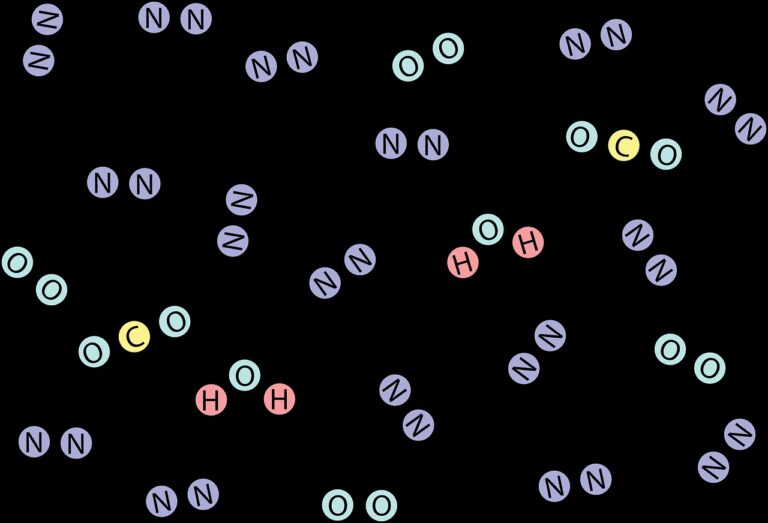
An ideal gas is a theoretical gas that is composed of a large number of tiny particles that are in constant random motion. In an ideal gas, the particles are assumed to be point masses with no volume, and they don’t interact with one another except when they collide elastically. Additionally, the collisions between particles and with the container walls are assumed to be perfectly elastic, meaning no energy is lost during the collision.
This simplified model allows us to make certain predictions about the behavior of gases, such as how they expand when heated, how they contract when cooled, and how they move in response to pressure differences. While no real gas exactly behaves like an ideal gas, this model is useful for understanding the basic behavior of gases and for making approximations in real-world situations.